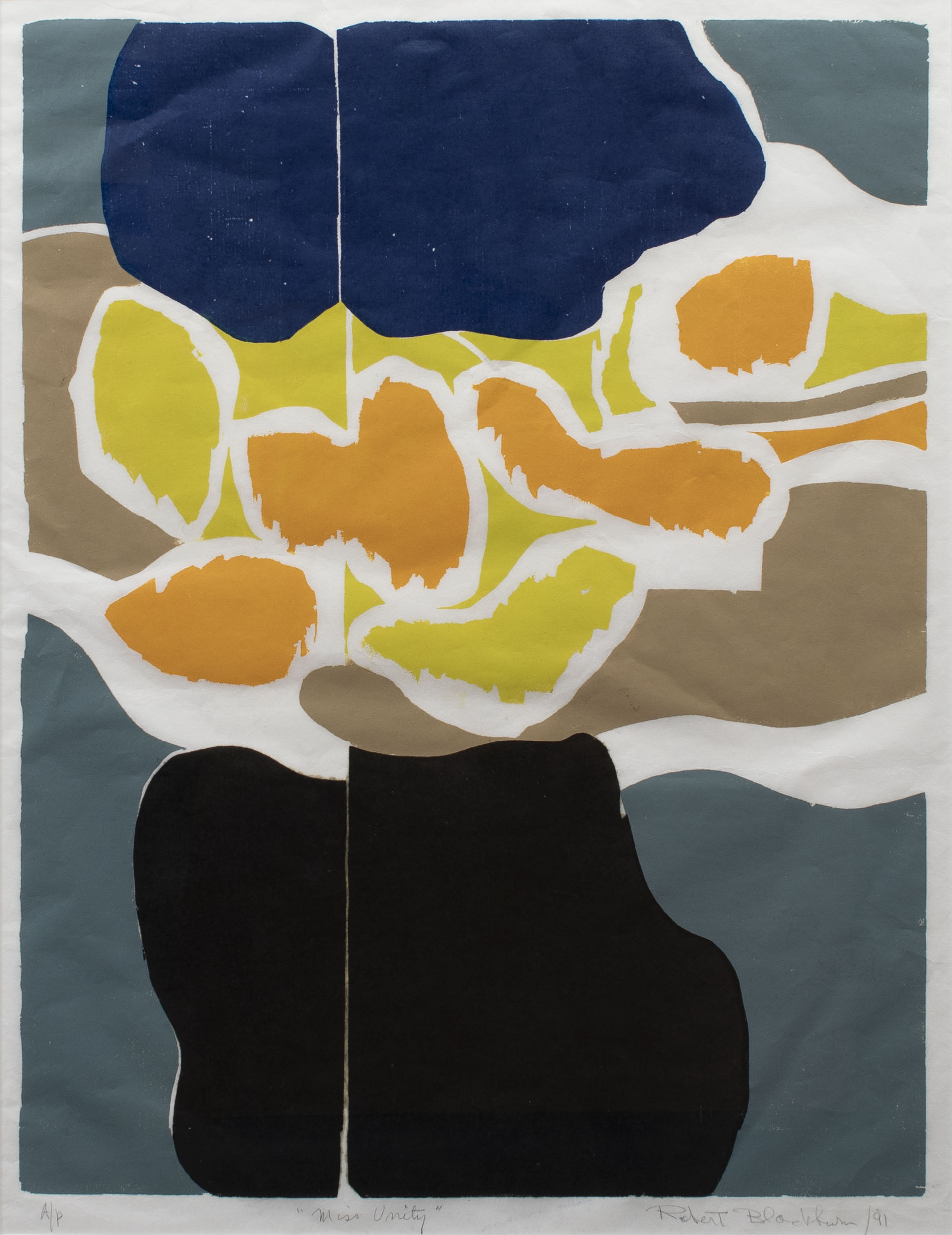
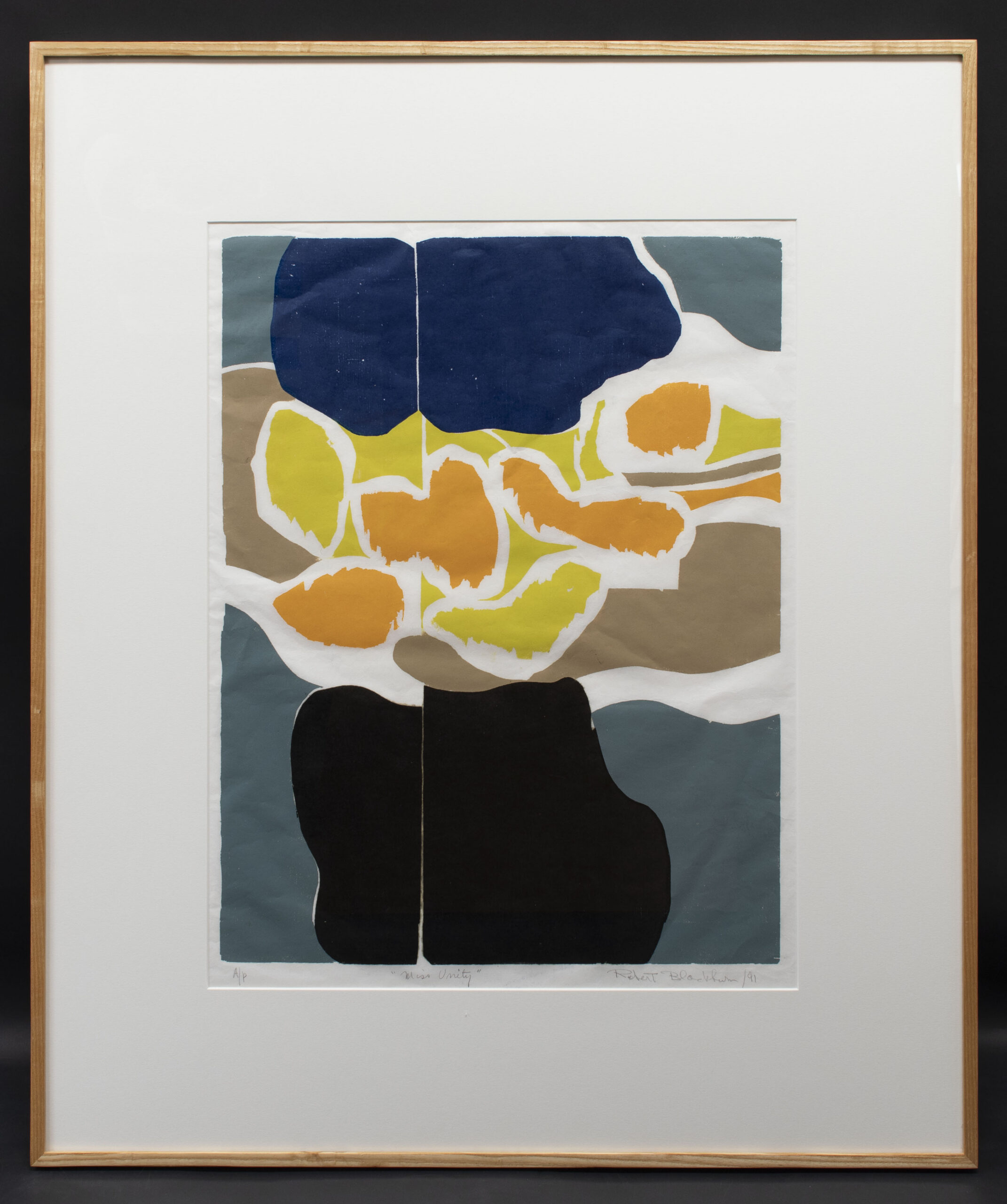
Miss Unity
1991
Robert Blackburn
Born 1920, Summit, NJ; died 2003, New York, NY
Object details
- Medium
Color woodcut on paper
- Dimensions
27 × 20 3/4 in. (68.58 × 52.7 cm)
- Credit
Purchase, with funds from the NEA Museum Program
- Object Number
1992.16
Robert Blackburn was an artist, printmaker, educator, and prolific facilitator of artistic communities. Born to Jamaican immigrant parents, Blackburn moved to Harlem in 1927, where he first learned about printmaking and lithography at the Harlem Arts Community Center, and attended DeWitt Clinton High School in the Bronx. In 1947, Blackburn established his Printmaking Workshop in Chelsea, where he provided accessible, low-cost printmaking equipment, instruction, and resources to artists of all homelands, ages, and backgrounds, including Romare Bearden, Faith Ringgold, and Robert Rauschenberg.
Miss Unity is a color woodcut printed from a 1974 original wood block by the artist, and the title suggests that collaboration and support is integral to the creative process. In the 1960s, Blackburn began to work extensively in woodcut to make abstractions like this one as he was interested in iterative experimentation with form and material rather than representation. In this print, the grain and texture of Blackburn’s wood block is especially apparent in darker blue segments at the top of the composition.
Español
Robert Blackburn fue artista, grabador, educador y prolífico facilitador de comunidades artísticas. Nacido de padres inmigrantes jamaicanos, Blackburn se mudó a Harlem en 1927, donde aprendió por primera vez sobre grabado y litografía en el Harlem Arts Community Center, y asistió a DeWitt Clinton High School en el Bronx. En 1947, Blackburn fundó su Printmaking Workshop en Chelsea, donde ofrecía a artistas de todas las procedencias, edades y trayectorias acceso a equipos, enseñanza y recursos de grabado asequibles y de bajo costo, entre ellos Romare Bearden, Faith Ringgold y Robert Rauschenberg.
Miss Unity es una xilografía a color impresa a partir de una matriz original de madera de 1974 realizada por el artista, y el título sugiere que la colaboración y el apoyo son parte integral del proceso creativo. En la década de 1960, Blackburn comenzó a trabajar extensamente con la xilografía para crear abstracciones como esta, pues le interesaba la experimentación iterativa con la forma y el material más que la representación. En esta impresión, la veta y la textura de la matriz de madera de Blackburn se hacen especialmente visibles en los segmentos azul oscuro de la parte superior de la composición.