Clifton
2010
Huma Bhabha
Born 1962, Karachi, Pakistan; lives and works in Poughkeepsie, NY
Object details
- Medium
Ink and collage on chromogenic print
- Dimensions
79 ½ × 49 in. (201.93 × 124.46 cm)
- Credit
Purchase, with funds provided by Carole Server and Oliver Frankel with additional funds from Salon 94
- Object Number
2013.22
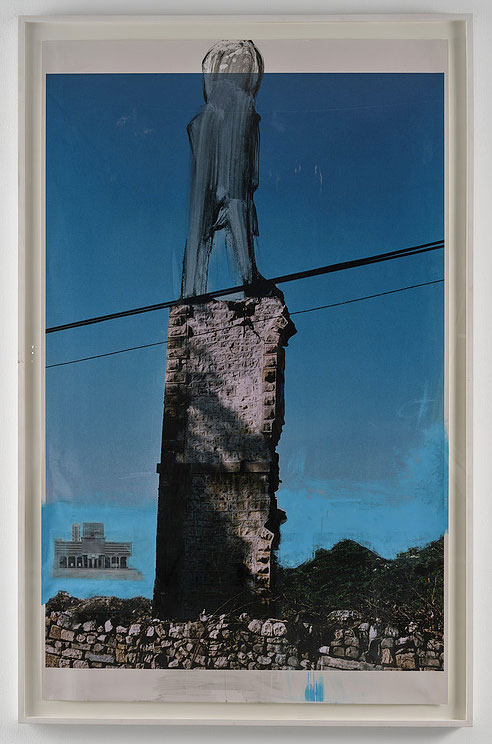
During a trip to her native Pakistan, Huma Bhabha took several photographs of rubble-filled landscapes and nondescript ruins, enlarged these images, and then drew, painted, and collaged over them. In Clifton, Bhabha activates a previously abandoned locale with an ink drawing of what looks to be a statued monument, transforming the weathered wall into a functioning plinth. The monument’s relationship to memory and place is further complicated by two elements: the power lines that cut horizontally through the photograph, markers of the modernity which has eclipsed these ruins, and a photograph of an ornate, arched building facade collaged onto the bottom left of the composition. Although the building is difficult to identify—as is the case in many of Bhabha’s photographs of architecture—it likely exists or did at one time in the affluent seaside neighborhood of Clifton, in Karachi, after which the work is titled. Bhabha’s intervention imagines landscapes of both decay and renewal over what was once a documentary image of a place.
Español
Durante un viaje a su Pakistán natal, Huma Bhabha tomó varias fotografías de paisajes llenos de escombros y ruinas anodinas, amplió esas imágenes y luego dibujó, pintó e hizo collage sobre ellas. En Clifton, Bhabha activa un lugar previamente abandonado con un dibujo en tinta de lo que parece ser un monumento escultórico, transformando el muro erosionado en un pedestal funcional. La relación del monumento con la memoria y el lugar se complica aún más por dos elementos: los cables eléctricos que atraviesan horizontalmente la fotografía, marcas de la modernidad que ha eclipsado esas ruinas, y una fotografía de la fachada ornamentada y arqueada de un edificio, incorporada en collage en la parte inferior izquierda de la composición. Aunque el edificio es difícil de identificar – como ocurre en muchas de las fotografías de arquitectura de Bhabha – probablemente existe o existió en algún momento en el acomodado barrio costero de Clifton, en Karachi, que da título a la obra. La intervención de Bhabha imagina paisajes tanto de decadencia como de renovación sobre lo que alguna vez fue una imagen documental de un lugar.