Project for Roosevelt Island Competition: Section of Proposal
1975
Juan Downey
Born 1940, Santiago, Chile; died 1993, New York, NY
Object details
- Medium
Collage, acrylic, colored pencil, and graphite on paper
- Dimensions
27 × 39 1/2 in. (68.5 × 100.3 cm)
- Credit
The Bronx Museum Purchase
- Object Number
2014.14.1
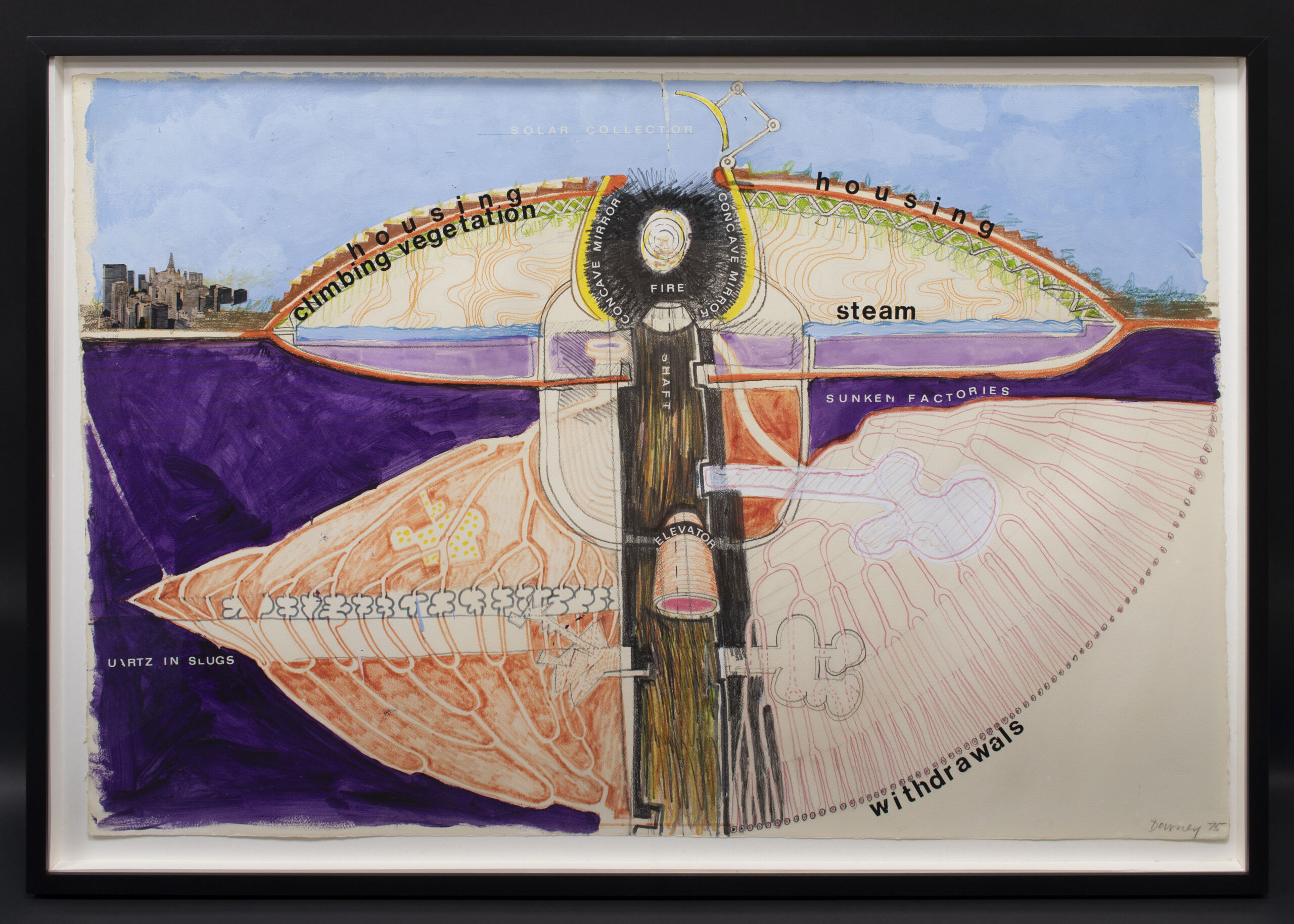
Trained as an architect, Juan Downey employed drawing, printmaking, video, architecture, and anthropology to imagine and visualize alternative ways of living and understanding people. He moved to Paris and then to New York City, where he created conceptual blueprints and sculptural installations activated by spectator movements. This work is loosely based on the sectional drawing commonplace in architecture, and Downey diagrams his plan for sustainable living on Roosevelt Island, with 20-story concave mirrors that would store solar energy, grow crops with steam from the East River, and power below-ground furnaces. His architectural approach imagines new healthy relationships between people and the environment as exemplified in this diagram in which housing and vegetation cohabitate. Informed by his experience as an immigrant, travels through the Americas, and the beginning of Augusto Pinochet’s dictatorship in Chile, Downey saw his work as a means to connect people across cultures and borders.
Español
Formado como arquitecto, Juan Downey empleó el dibujo, el grabado, el video, la arquitectura y la antropología para imaginar y visualizar formas alternativas de vivir y comprender a las personas. Se mudó a París y luego a la ciudad de Nueva York, donde creó planos conceptuales e instalaciones escultóricas activadas por los movimientos del espectador. Esta obra se basa libremente en el dibujo en sección, común en la arquitectura, y en ella Downey diagrama su plan para una vida sostenible en Roosevelt Island, con espejos cóncavos de veinte pisos que almacenarían energía solar, permitirían cultivar con vapor del East River y alimentarían hornos subterráneos. Su enfoque arquitectónico imagina nuevas relaciones saludables entre las personas y el entorno, como ejemplifica este diagrama en el que la vivienda y la vegetación cohabitan. Marcado por su experiencia como inmigrante, sus viajes por las Américas y el inicio de la dictadura de Augusto Pinochet en Chile, Downey entendía su obra como un medio para conectar a personas a través de culturas y fronteras.